
Russell Winterburn-Makereti Papakura. Rotorua Guide
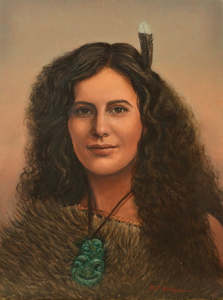
Oil on canvas framed size 480mm x 580mm $9950.00 An absolutely brilliant read. Margaret Pattison Thom, who was later widely known as Mākereti (or Maggie) Papakura, was born at Matatā, in the Bay of Plenty, on 20 October 1873. Her father was an Englishman, William Arthur Thom, a storekeeper who later worked in the Resident Magistrate's Court at Rotorua, and then at Wairoa. Her mother was Pia Ngarotū Te Rihi, a high-born Te Arawa woman of Ngāti Wāhiao hapū of Tūhourangi, who was descended from Te Arawa chiefs Tamatekapua, Ngātoroirangi, Hei and Ika. Soon after her birth, Mākereti was taken to the rural community of Parekārangi to be raised by her mother's paternal aunt and uncle, Mārara Marotaua and Maihi Te Kakau Parāoa. It was from them that Mākereti learnt the genealogies, history and customs of her tribe. Mākereti did not speak English until her father took over her education when she was 10 years old. Periods spent at schools in Rotorua and Tauranga, tuition from an English governess, and three years at Hukarere Native Girls' School, Napier, gave her the language skills and confidence to move with aplomb between the Pākehā and Māori worlds. On leaving school, Mākereti went to live at Whakarewarewa, the ancestral home of her people. The Rotorua region was beginning to recover after the devastating eruption of Mt Tarawera in 1886, and the tourist guiding tradition, which had started at Te Wairoa with expeditions to the world-famous Pink and White Terraces, was transferred to the thermal valley of Whakarewarewa. Under the experienced eye of Guide Sophia Hinerangi, Mākereti became an accomplished hostess, entertainer and storyteller. Renowned for her beauty, charm and ready wit, her services as a guide were keenly sought. On one occasion, when asked by a visitor if she had a Māori surname, Mākereti glanced for inspiration to a nearby geyser which was called Papakura and immediately responded, 'My name is Papakura, Maggie Papakura'. From that time on she was widely known as Guide Maggie Papakura. The name Papakura was also assumed by close members of her family. On 7 May 1891 at Wairoa, her father's place of residence, Mākereti married Francis (Frank) Joseph Dennan, a surveyor. Her only child, William Francis (Te Aonui) Dennan, was born later that year. Mākereti lived for a short while in Wairarapa with her husband, but when he left to work in the Taupō district she returned to Whakarewarewa. They were never reunited and Mākereti petitioned for divorce in 1900. Guiding provided a source of income for her while her son was growing up. In 1901 Mākereti achieved international recognition when, in front of a large crowd, she welcomed the duke and duchess of Cornwall and York on their visit to Rotorua. Thereafter she was in even greater demand as a guide. Before 1910 she made a number of brief trips to Australia, and her social activities attracted comment in the society columns of local newspapers and magazines. Mākereti was a popular subject for photographers, notably E. W. Payton, C. P. Parkerson and George Isles. Postcards of her clothed in Pākehā or Māori costume, with the headscarf she usually wore when guiding, were widely available. The welfare of her people was always a major concern for Mākereti. Her natural leadership qualities soon earned her respect within her local community and she was a strong advocate for the right of the Māori to self-determination. She had powerful friends, including prominent leaders and politicians such as Peter Buck, Māui Pōmare and Apirana Ngata, and she was not slow to appeal to them for help. Mākereti had a keen entrepreneurial sense and was interested in promoting aspects of Māori culture to gain economic benefits for her people. She wrote a book, entitled Guide to the hot lakes district (1905), and formed a concert party with her sister Bella, who was an exponent of waiata and poi. The Reverend Frederick Bennett wrote items for this group. In 1910 Mākereti and her cultural group were invited to take part in a Sydney exhibition. Here they gave concert performances and set up a model Māori village. Such was the success of this venture that Mākereti was asked by a syndicate of Sydney businessmen to manage a Māori concert party tour to Sydney and then to England to take part in the Festival of Empire celebrations. Mākereti gathered together a touring party consisting of around 40 members of her extended family, including her sister Bella, brother Tiki (Dick) Papakura, the Tūhourangi leader Mita Taupopoki, and a selected group of the finest singers and performers. In April 1911 they left Sydney for London. They appeared at various venues including Crystal Palace, the Palace Theatre and White City and entertained thousands of visitors with songs and dances, story-telling and whaikōrero (speech-making). An accompanying exhibition of Māori artefacts, including a meeting house and storehouse, was equally popular with the crowds. The n
- Price:
- $9,950
×