
Yellowchest Twist Wrasse
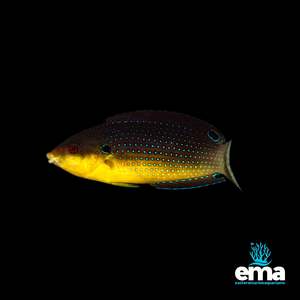
The a moderately-sized wrasse with a sleek, elongated body with dorsal and anal fins that extend almost the entire length of the fish. Towards the rear of these fins are a pair of large, deep-blue eyespots that help protect the fish by disorienting or confusing potential predators. The beautifully colored primarily dark blue to purple in coloration with many vibrant bright blue dots. The bottom front half of the bright yellow or gold in coloration which lends to its common name. In the wild, the a reef associated species found throughout the Indo-Pacific Ocean with populations also found in the Red Sea to the Tuamoto Islands, north to the Ryukyu Islands and south to Rapa.
For best care, the should be housed in an established, well-filtered aquarium of at least 120 gallons in size or larger. A layer of fine sandy substrate 2-3 inches in depth is essential for the as it will burrow into the sand to sleep or to seek shelter when it feels threatened. Do not use crushed coral or other coarse substrate as the has a poor survival rate in systems with such coarse substrates. The ideal aquarium setup will also have plenty of live rock. Be sure to arrange your aquarium landscape so there are ample nooks and crannies for your to explore, seek refuge, or forage for food. As juveniles, the may be kept in numbers but keep in mind that they may demonstrate aggression towards each other when fully grown.
The natural diet of the consists of benthic invertebrates and as such, large hungry may pick at desirable ornamental invertebrates including fan worms, shrimp, and other crustaceans in the home aquarium. However, the typically will not harm sessile invertebrates including soft or stony corals. In the home aquarium, the diet of the should consist of a diverse variety of food items including vitamin-enriched frozen mysis shrimp, vitamin-enriched frozen brine shrimp, and other meaty foods along with high-quality marine flakes and marine pellet foods.
Source: Live Aquaria
0
0
For best care, the should be housed in an established, well-filtered aquarium of at least 120 gallons in size or larger. A layer of fine sandy substrate 2-3 inches in depth is essential for the as it will burrow into the sand to sleep or to seek shelter when it feels threatened. Do not use crushed coral or other coarse substrate as the has a poor survival rate in systems with such coarse substrates. The ideal aquarium setup will also have plenty of live rock. Be sure to arrange your aquarium landscape so there are ample nooks and crannies for your to explore, seek refuge, or forage for food. As juveniles, the may be kept in numbers but keep in mind that they may demonstrate aggression towards each other when fully grown.
The natural diet of the consists of benthic invertebrates and as such, large hungry may pick at desirable ornamental invertebrates including fan worms, shrimp, and other crustaceans in the home aquarium. However, the typically will not harm sessile invertebrates including soft or stony corals. In the home aquarium, the diet of the should consist of a diverse variety of food items including vitamin-enriched frozen mysis shrimp, vitamin-enriched frozen brine shrimp, and other meaty foods along with high-quality marine flakes and marine pellet foods.
Source: Live Aquaria
×