
Everlast Thunder 255 MTS Pulse MIG, DC TIG & Stick Welder
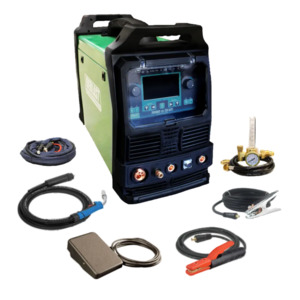
- Variable MIG inductance
- Adjustable Stick Arc Force
- High Frequency TIG start
- Lift TIG start
- Single Pulse MIG
- TIG pulse frequency: 0–500 Hz
- TIG pulse duty cycle: 5–95%
- Heavy-duty 4-roll wire drive
- Integrated wire feeder
- Wire feed speed up to 15.2 m/min
- Accepts 300 mm wire spools
- 30-program memory
- Standard foot pedal included
- Spool gun compatible
- Push-Pull gun compatible
- 2T / 4T trigger operation Welding Capacity Steel & Stainless Steel (MIG)
- Single-pass welding up to 11 mm
- Multi-pass welding over 19 mm
- Minimum material thickness approximately 0.6 mm Aluminium (MIG)
Using the supplied MIG torch with a PTFE liner and U-groove drive rolls:
- Single-pass welding up to 10 mm
- Multi-pass welding over 19 mm
- Minimum material thickness approximately 2 mm
For longer aluminium welds, a Push-Pull torch such as the Parker SG360A or Parker DSP360 is recommended. DC TIG
- Single-pass welding up to 13 mm
- Multi-pass welding up to 19 mm
- Minimum material thickness approximately 0.4 mm Stick Welding
- Electrode size: 1.6–4.8 mm
Maximum electrode size and welding performance will vary depending on electrode type, manufacturer recommendations and welding application. Generator Requirements
When operating from a generator, use only a clean sine wave generator with 5% Total Harmonic Distortion (THD) or less.
Recommended minimum generator capacity:
- 13 kVA (13,000 W) surge output
Using a generator with excessive THD or insufficient output may damage the machine and void the warranty. Notes
- Smaller wire sizes may require optional drive rolls, liners or MIG torches for optimum wire feed performance.
- Aluminium welding requires a PTFE liner together with U-groove drive rolls.
- For best performance with 0.6 mm and 0.8 mm wire, a smaller MIG torch and matching liner are recommended.
- Extended or dedicated gasless flux-cored welding is best performed using a dedicated flux-cored MIG torch.
- Power plug not included. Installation should be completed by a qualified electrician using the appropriate connector for a 220–240 V single-phase power supply.