
The True Believer
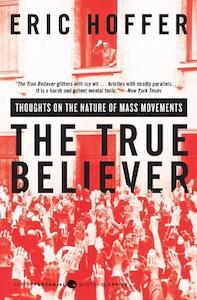
Eric Hoffer's delves deeply into the psychology and dynamics behind mass movements and fanaticism. This seminal work, written with both intellectual rigor and accessible prose, examines how and why individuals become willing to sacrifice their individuality for the collective. Hoffer breaks down the essential elements that drive these movements, from the disillusionment of the followers to the charismatic leadership that catalyses their fervour. Instead of focusing on a specific narrative or plot, the book presents a series of insightful observations and analyses, supported by historical examples and philosophical discourse, making it an invaluable resource for understanding the nature of collective human behaviour.
Eric Hoffer was a stevedore on the San Francisco docks in the 1940s who wrote philosophical treatises in his spare time while living in the railroad yards. was the first and most acclaimed of his works, achieving bestseller status after President Eisenhower cited it during one of the earliest televised press conferences. The book's reach and impact have only grown since then, solidifying its place as a timeless exploration of the forces that shape ideologies and mass movements.
Hoffer's unexpected rise to intellectual prominence is a compelling story in itself. He appeared on public television in 1964 and later participated in two one-hour conversations on CBS with Eric Severeid. These appearances elevated him to the status of a public philosopher, comparable to figures like Joseph Campbell. Remarkably, Hoffer had no formal education, having chosen the life of a manual labourer. This fact only amplifies the significance of his insights and contributions to political and social thought.
This compact yet profoundly impactful manual on the nature of fanaticism has often been likened to Machiavelli’s The Prince. Just as Machiavelli provided a pragmatic guide to political leadership, Hoffer offers a powerful analysis of the forces that drive individuals to abandon their personal desires and embrace collective causes, often with fanatic zeal. Through a blend of philosophical depth and practical observation, remains pertinent to understanding contemporary social movements and the human psyche.