
Movie Making with LEGO
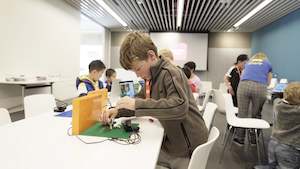
Inspire your students as they learn basic film making principles and LEGO-specific techniques to produce their own LEGO stop motion animation movies. With access to everything a young animator needs, this workshop is suitable for beginner and experienced movie makers alike, and can run as a one-off or a series of sessions.
Age range: 7-15 years old (Years 2-10)
Session Length: 60 minutes
Price: $6.50 per child per hour (Minimum $80 per hour)
Capacity: Up to 32 students working in pairs
Key Concepts
- - Stop motion animation is a way of making movies from a series of photos of static objects like LEGO
- - Taking more photos increases the frames per second and creates a smoother viewing experience
- Characters and setting need to move and change in realistic ways to create an understandable story
Lesson Description
Depending on your numbers, students work in pairs or individually to create a stop motion animation film using our LEGO and iKit movie software. We give our best tips to make a smooth film. Students’ films are shared with the teacher to be enjoyed by the group after your visit to Imagination Station.
Learning Outcomes
We are learning to:
- - Visually represent a story
- - Use visual elements like set and character coding to give our audience clues
- - Use stop-motion animation software to produce a movie with enough frames per second to deliver a story
Curriculum Links
English
- Speaking, Writing and Presenting: Purposes and Audiences (Levels 2-5)
- - Show some understanding of how to shape texts for different purposes and audiences. (Level 2)
- - Show a developing understanding of how to shape texts for different purposes and audiences. (Level 3)
- - Show an increasing understanding of how to shape texts for different purposes and audiences. (Level 4)
- - Show an understanding of how to shape texts for different audiences and purposes. (Level 5)
- Speaking, Writing and Presenting: Ideas (Levels 2-5)
- - Select, form, and express ideas on a range of topics. (Level 2)
- - Select, form, and communicate ideas on a range of topics. (Level 3)
- - Select, develop, and communicate ideas on a range of topics. (Level 4)
- - Select, develop, and communicate purposeful ideas on a range of topics. (Level 5)
- Speaking, Writing and Presenting: Structure (Levels 1-3)
- - Organise texts, using simple structures. (Level 1)
- - Organise texts, using a range of structures. (Level 2)
- - Organise texts, using a range of appropriate structures. (Level 3)
The Arts
- Drama: Developing Practical Knowledge (Levels 1-4)
- - Explore the elements of role, focus, action, tension, time, and space through dramatic play. (Level 1)
- - Explore and use elements of drama for different purposes. (Level 2)
- - Use techniques and relevant technologies to explore drama elements and conventions. (Level 3)
- - Select and use techniques and relevant technologies to develop drama practice. (Level 4)
- - Use conventions to structure drama. (Level 4)
Drama: Developing Ideas (Levels 1-4)
- - Contribute and develop ideas in drama, using personal experience and imagination. (Level 1)
- - Develop and sustain ideas in drama, based on personal experience and imagination. (Level 2)
- - Initiate and develop ideas with others to create drama. (Level 3)
- - Initiate and refine ideas with others to plan and develop drama. (Level 4)
Technology
Technological Practice: Planning for Practice (Levels 1-3)
- - Outline a general plan to support the development of an outcome, identifying appropriate steps and resources. (Level 1)
- - Develop a plan that identifies the key stages and the resources required to complete an outcome. (Level 2)
- - Undertake planning to identify the key stages and resources required to develop an outcome. Revisit planning to include reviews of progress and identify implications for subsequent decision making. (Level 3)
Key Competencies
- Thinking:
- Students use creative thinking to tell a story visually.
- Using language, symbols and text:
- Students are reliant on visual language cues and film making conventions until their film is finished, at which point early finishers may have time to add sound effects that support th
- Store:
- LUG 42