
3RDAX™ ASA-GF Glass Fiber 1.75mm
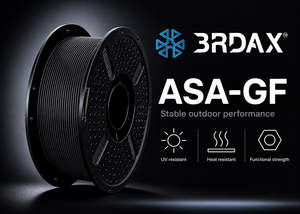
ABOUT THIS FILAMENT
ASA-GF takes the outdoor durability and heat resistance of standard ASA and reinforces it with Glass Fiber to improve stiffness, dimensional stability, and performance under load. It keeps the same strong UV resistance and weather stability that make ASA such a practical material for outdoor and automotive use, while improving structural stability and reducing movement in parts under heat or mechanical stress.
Compared to standard ASA, the added Glass Fiber helps the material hold its shape more consistently, particularly in larger parts or applications where heat and load can cause flex over time. It also offers a more stable printing profile for parts where accuracy and consistency matter.
Like standard ASA, it is still a proper functional material. It requires more care than PLA or PETG, but rewards that extra effort with durable, stable parts suited to demanding real world environments.
WHERE IT WORKS BEST
ASA-GF works best in applications where parts need to maintain their shape under heat, load, or long term outdoor exposure. This makes it a strong choice for automotive mounts, engine bay covers, external housings, structural brackets, machine guards, marine fittings, and workshop tooling where long term stability matters more than flexibility.
It is particularly useful for larger or flatter parts where standard ASA may still perform well, but where added stiffness and improved dimensional stability help keep the part more consistent over time.
For users wanting a stronger structural material without stepping fully into high end engineering plastics, ASA-GF offers a practical middle ground.
WHERE IT COMES FROM
ASA-GF starts with standard ASA, a petroleum based thermoplastic derived from crude oil and natural gas. These raw materials are refined into the chemical building blocks used to create the polymer, primarily acrylonitrile, styrene, and acrylic rubber.
This is where ASA differs from ABS. While ABS uses butadiene rubber, ASA uses an acrylic based rubber instead. That change gives ASA its stronger resistance to UV exposure, weathering, and long term environmental ageing, while still keeping much of the strength, toughness, and printability that makes ABS so widely used.
That base material is then reinforced with chopped Glass Fiber, which changes the way the material behaves by increasing stiffness, reducing flex, and improving dimensional stability, particularly under heat or sustained load. This gives the material a stronger structural profile while maintaining the outdoor performance ASA is known for.
PRINTING WITH IT
ASA-GF prints much like standard ASA, but with the added abrasion that comes with Glass Fiber reinforcement. It still benefits heavily from an enclosure, stable temperatures, and strong bed adhesion, especially on larger parts where warping or lifting can still occur.
Because of the abrasive Glass Fiber content, a hardened nozzle is essential. Brass nozzles are not recommended, as wear will quickly affect print quality and dimensional accuracy.
Bed adhesion remains important, particularly on larger flat parts or sharper cornered prints. A quality build surface and adhesive, such as Dimafix, can make a significant difference in reducing edge lift and improving first layer hold.
Like standard ASA, it also produces noticeable fumes during printing, so ventilation is recommended. The Glass Fiber reinforcement can also improve dimensional stability during printing, often reducing shrink related movement and helping larger parts hold shape more consistently.
MATERIAL COMPATIBILITY
ASA-GF behaves best as a single material print and bonds reliably to itself when printed correctly.
For supported prints, materials designed for higher temperature environments such as HIPS are often the most suitable pairing, as they better match ASA-GF’s printing temperatures and enclosure requirements. This helps maintain cleaner interfaces and more predictable support removal.
Like standard ASA, it does not naturally pair well with PLA or PETG due to the large differences in print temperatures and shrink behaviour. Because of the Glass Fiber content, support tuning may also require some adjustment compared to standard ASA, especially for tighter interface layers or more detailed support contact areas.
BASE, CARBON OR GLASS?
Standard ASA remains the better all round option when impact resistance, toughness, and some flexibility are more important. It is often the safer choice for parts that may take repeated knocks, vibration, or movement.
ASA Carbon Fiber shifts the balance toward maximum stiffness, reduced flex, and cleaner aesthetics, making it better suited to rigid structural parts where