
3RDAX™ PETG-CF15 Carbon Fiber 1.75mm
ABOUT THIS FILAMENT
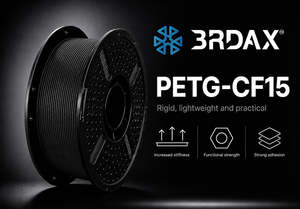
PETG-CF15 takes the easy printing behaviour and strong layer adhesion of standard PETG and reinforces it with 15% Carbon Fiber to push stiffness, reduce flex, and increase dimensional stability even further. It keeps the low warp characteristics and durability that make PETG such a practical functional material, while delivering an even stronger and more rigid structural feel than PETG-CF12.
This sits at the top of the reinforced PETG range for users wanting maximum rigidity and structural stability without stepping into more demanding engineering materials. Layer adhesion remains strong, strength remains high, and the finished parts offer a firm, solid feel that stands out in functional applications.
This current batch does differ slightly from previous runs. The higher Carbon Fiber loading makes the filament itself a little more brittle in spool form, and the finished surface tends to have a rougher, more textured feel compared to earlier batches. Print performance and strength remain strong, but it does require slightly more attention during printing and handling.
That makes it a strong option for users who want the highest rigidity in the PETG Carbon Fiber range and do not mind trading a little ease of handling for greater structural performance.
WHERE IT WORKS BEST
PETG-CF15 works best for functional parts where maximum stiffness, structural rigidity, and dimensional stability are the priority. It is well suited to brackets, mounts, jigs, fixtures, tool holders, housings, and machine parts where flex needs to be kept to a minimum.
It is particularly useful for workshop parts, structural brackets, automotive mounts, housings, and functional components where strength and stiffness take priority over flexibility or impact absorption.
For users wanting the most rigid option in the PETG range, PETG-CF15 is the highest step before moving into more specialised engineering plastics.
WHERE IT COMES FROM
PETG-CF15 starts with PETG, a glycol modified polyester derived from petroleum based raw materials. These are refined into chemical building blocks and processed into a thermoplastic designed for strong layer adhesion, low shrinkage, and good chemical resistance.
The glycol modification separates PETG from standard PET, reducing brittleness and improving printability by making the material easier to process and less prone to crystallisation.
That base material is then reinforced with 15% chopped Carbon Fiber, increasing stiffness, reducing flex, and improving dimensional stability even further. This increased Carbon Fiber loading gives the material its stronger structural feel and higher rigidity over both standard PETG and PETG-CF12, while also contributing to the rougher surface finish and more brittle filament behaviour often associated with higher Carbon Fiber loading.
PRINTING WITH IT
PETG-CF15 prints similarly to PETG-CF12, but the increased Carbon Fiber content makes the filament more abrasive and slightly less forgiving. A hardened steel nozzle is essential. Standard brass nozzles are not recommended.
This current batch uses a slightly coarser Carbon Fiber blend, which can produce a rougher surface finish and may require more attention to nozzle cleanliness during longer prints. In some setups, larger nozzle sizes or occasional cold pulls can help maintain more consistent extrusion and reduce the chance of partial blockages.
It does not require an enclosure and remains easier to print than many engineering materials, but slower print speeds and stable temperatures will generally produce the best results.
Like standard PETG, moisture can affect print quality, so drying before use is recommended for the best surface finish, layer adhesion, and extrusion consistency.
MATERIAL COMPATIBILITY
PETG-CF15 performs best as a single material print and bonds reliably to itself when printed correctly.
For support materials, PETG itself can often be used effectively depending on the part and setup, though support tuning may need adjustment due to the stiffer reinforced structure.
Like standard PETG, it does not naturally bond well to PLA, which can sometimes be useful in multi material setups where easier support separation is preferred.
BASE, CARBON OR GLASS?
Standard PETG remains the better all round option when impact resistance, flexibility, and ease of printing are the priority. It is more forgiving, less abrasive, and often the better choice for general purpose parts that may need to flex or absorb repeated knocks.
Within the reinforced PETG range, PETG-CF12 remains the more balanced option, offering strong stiffness and dimensional stability while staying slightly easier to print and tune