
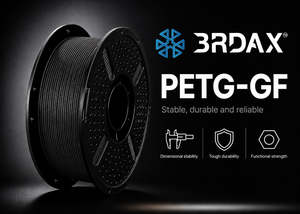
3RDAX™ PETG-GF Glass Fiber 1.75mm
ABOUT THIS FILAMENT
PETG-GF takes the easy printing behaviour and strong layer adhesion of standard PETG and reinforces it with Glass Fiber to improve stiffness, reduce flex, and increase dimensional stability. It keeps the low warp characteristics and strong durability that make PETG such a practical everyday functional material, while improving its structural stability for more demanding applications.
Compared to standard PETG, the added Glass Fiber gives the material a more rigid feel and helps parts hold their shape more consistently under load or heat. This makes it a strong step up for functional prints where standard PETG may still feel too flexible.
It remains easier to print than many engineering materials such as ABS, ASA, or Polycarbonate, while offering improved rigidity and stability over standard PETG.
WHERE IT WORKS BEST
PETG-GF works best for functional parts where stiffness, durability, and dimensional stability matter more than flexibility. It is well suited to brackets, mounts, housings, jigs, fixtures, tool holders, machine parts, and workshop components where reduced flex and stronger load handling are beneficial.
It is particularly useful where standard PETG may still feel too soft, but where the higher print demands of ABS, ASA, or PC are unnecessary.
For many users, PETG-GF offers a strong middle ground between easy printing and more capable functional performance.
WHERE IT COMES FROM
PETG-GF starts with PETG, a glycol modified polyester derived from petroleum based raw materials. These are refined into chemical building blocks and processed into a thermoplastic designed for strong layer adhesion, low shrinkage, and good chemical resistance.
The glycol modification is what separates PETG from standard PET, reducing brittleness and improving printability by making the material easier to process and less prone to crystallisation.
That base material is then reinforced with chopped Glass Fiber, which improves stiffness, reduces flex, and increases dimensional stability. This gives the material a stronger structural profile while maintaining the easy printing behaviour PETG is known for.
PRINTING WITH IT
PETG-GF prints similarly to standard PETG, but with the added abrasion that comes with Glass Fiber reinforcement. It still remains one of the easier reinforced materials to work with and does not normally require an enclosure.
Because of the abrasive Glass Fiber content, a hardened nozzle is essential. Brass nozzles are not recommended, as wear will quickly affect print quality and dimensional accuracy.
PETG-GF often benefits from slightly slower print speeds than standard PETG to maintain consistent layer bonding and dimensional accuracy. Cooling is still useful, but should be balanced to maintain strong layer adhesion.
Like standard PETG, moisture can affect print quality, so drying before use is recommended for the best surface finish and extrusion consistency.
MATERIAL COMPATIBILITY
PETG-GF performs best as a single material print and bonds reliably to itself when printed correctly.
For support materials, PETG itself can often be used effectively depending on the part and setup, though support tuning may need adjustment due to the stiffer reinforced structure.
Like standard PETG, it does not naturally bond well to PLA, which can sometimes be useful in multi material setups where easier support separation is preferred.
BASE, CARBON OR GLASS?
Standard PETG remains the better all round option when impact resistance, toughness, and some flexibility are more important. It is often the better choice for parts that may take repeated knocks or movement.
PETG Carbon Fiber shifts the balance toward stiffness, dimensional stability, and cleaner aesthetics, making it better suited to rigid parts where appearance and precision matter.
PETG Glass Fiber focuses more on structural stability and load handling, improving stiffness while often retaining a stronger balance of durability. This makes it a strong option for functional parts where strength and long term stability matter more than surface finish.
For parts where rigidity, durability, and reduced flex are the priority, PETG-GF is often the better fit.
TECHNICAL DATA
Material Type: PETG-GF
Diameter: 1.75 mm ± 0.03 mm
Net Weight: 1 kg
Composition: Polyethylene Terephthalate Glycol, Glass Fiber
Density: 1.28 g/cm³
Approx. Length per kg: 325 m
Vicat Softening Temperature: 72 °C
Tensile Strength (Yield): 53 MPa
Elongation at Break: 98%
Flexural Modulus: 1986 MPa
Certifications: CE and RoHS