
3RDAX™ PLA 1.75mm
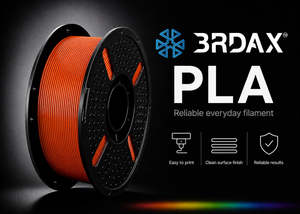
ABOUT THIS FILAMENT
PLA is the easy starting point for 3D printing, but that does not mean it is only for beginners. It is reliable, clean to print, and a good choice when you want parts to come out consistently without spending half the day chasing settings.
It is not the strongest or most heat resistant material in the range, and it should not be treated like an engineering plastic. That is part of the point. PLA is good because it is predictable, easy to use, and gives tidy results on most printers without needing special equipment.
A NOTE ON PLA
This filament is listed as PLA, not PLA , on purpose. It does include additives to improve printability and performance, as most modern PLA filaments do, but PLA is not a standardised material grade.
One brand’s PLA can be very different from another’s, and the label does not always explain what has actually changed. Calling it PLA keeps the naming clear, while the technical data shows what the filament actually offers.
It still prints very well, gives reliable results, and is not a “basic" PLA in the cheap and nasty sense. Clear information matters more than vague naming, so the focus is on how the filament actually performs. Try it for yourself and see how it runs on your own printer.
WHERE IT WORKS BEST
PLA works best for prototypes, display models, decorative parts, organisers, templates, light duty brackets, jigs, fixtures, and general purpose workshop prints. It is a sensible choice when the part needs to look tidy, hold its shape, and not be exposed to high heat or heavy mechanical load.
It is also useful for proving a design before moving to something more expensive or more difficult to print. If a design does not work in PLA, it is often worth fixing the design first before blaming the material or jumping to PETG, ABS, ASA, PC, or reinforced filaments.
WHERE IT COMES FROM
PLA stands for polylactic acid. It is made from plant based starches such as corn, sugarcane, or cassava. Those starches are fermented into lactic acid, which is then processed into a plastic that can be extruded into filament.
That makes PLA different from traditional petroleum based plastics like ABS or PETG. It comes from renewable biological sources rather than crude oil or natural gas. That does not mean it is magic, and it does not mean it disappears in the garden after a week. It is still a processed plastic, but its starting point is plant based rather than fossil fuel based.
PLA is often described as biodegradable or compostable, but the detail matters. It generally needs industrial composting conditions to break down properly. It will not behave like food scraps in a home compost bin. PLA can also be recycled into new filament in some setups, but it needs to be kept clean and separated from other plastics.
PRINTING WITH IT
PLA is one of the easiest materials to print. It does not usually need an enclosure, does not need extreme temperatures, and works well on most standard FDM printers. That makes it a good choice when you want reliable results without needing a highly tuned machine.
PLA is also a useful baseline material for troubleshooting. If a printer cannot produce clean PLA parts, it usually points to something in the printer setup, slicer profile, bed prep, or filament condition. It is often the first material to test before moving on to more demanding filaments.
MATERIAL COMPATIBILITY
PLA behaves well as a single material print. It bonds to itself reliably, which is part of why it is such a dependable everyday filament.
Where it gets more interesting is with support materials. PLA can be paired with PVA when soluble supports are needed, depending on the printer setup. It also does not bond strongly to PETG, which can be useful rather than annoying. In the right multi material setup, that weaker bond can make PETG useful as a support interface for PLA, helping supports release more cleanly after printing.
BASE, CARBON OR GLASS?
Standard PLA is the more forgiving option. It is easy to print, less abrasive, and well suited to general use. PLA CF adds carbon fibre for a stiffer feel, cleaner surface finish, and a more technical look. It is a good choice when you want a rigid part with reduced flex and a matte finish.
A glass filled PLA option is not available at this stage. For now, the choice is simple: standard PLA for everyday reliable printing, or PLA CF when stiffness, appearance, and reduced flex are the priority.
TECHNICAL DATA
Material Type: PLA
Diameter: 1.75 mm ± 0.03 mm
Net Weight: 1 kg
Composition: PLA, Polylactic Acid
Density: 1.25 g/cm³
Approx. Length p