
3RDAX™ Polycarbonate+ 1.75mm
ABOUT THIS FILAMENT
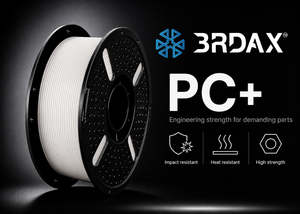
PC is a Polycarbonate based copolyester filament designed to deliver the strength, toughness, and heat resistance associated with Polycarbonate, while improving printability. It is one of the stronger and more heat capable materials available in FDM printing, making it a serious option for functional parts that need to perform under load, heat, or impact.
Compared to traditional Polycarbonate grades, PC offers improved layer adhesion and reduced warping, while still maintaining the high strength and thermal stability that make Polycarbonate so widely respected. That makes it a far more practical option for demanding prints without losing the core benefits of the base material.
It is not a beginner material and demands more from both the printer and the operator, but when printed correctly it produces strong, durable parts that sit well above PLA, PETG, ABS, or ASA in outright performance.
WHERE IT WORKS BEST
PC works best for functional parts where strength, impact resistance, and heat stability are critical. It is well suited to brackets, mounts, machine parts, tooling, enclosures, automotive components, and structural parts where standard materials may not be enough.
It is particularly useful in higher heat environments or parts exposed to repeated mechanical stress, where lower temperature materials may soften, flex, or fail over time.
For users wanting serious functional performance without stepping into more specialised materials like nylon composites, PC offers one of the strongest all round options available.
WHERE IT COMES FROM
PC is a Polycarbonate based copolyester derived from petroleum based raw materials. These are refined into chemical building blocks and combined into a modified polymer blend designed to balance strength, impact resistance, heat stability, and improved processability.
This base material is known for its high strength, excellent impact resistance, and strong heat performance, which is why it is widely used in industrial components, safety equipment, automotive parts, and structural products.
The “plus" in PC refers to performance modifiers blended into the Polycarbonate copolyester base to improve printability, reduce warping, and improve layer adhesion while retaining the strength and thermal performance the material is designed for.
PRINTING WITH IT
PC is significantly more demanding to print than PLA, PETG, ABS, or ASA and performs best on a fully enclosed printer capable of maintaining stable chamber temperatures.
It requires higher nozzle temperatures, strong bed adhesion, and consistent thermal control to prevent warping, splitting, or poor layer bonding. Larger parts especially benefit from minimal airflow and a warm build environment.
Bed adhesion is critical with PC , and products like Dimafix can make a major difference in improving first layer hold and reducing lift on larger or high stress prints.
Like many engineering plastics, drying before use is strongly recommended. PC absorbs moisture more readily than PLA or ABS, and wet filament will quickly affect print quality, surface finish, and layer strength.
MATERIAL COMPATIBILITY
PC performs best as a single material print and bonds strongly to itself when printed correctly.
For supported prints, higher temperature support materials such as HIPS are often the most practical pairing, as they better match PC printing temperatures and chamber requirements. Lower temperature materials such as PLA or PETG are generally not suitable due to the large difference in print temperatures and material behaviour.
BASE, CARBON OR GLASS?
PC offers a strong balance of toughness, impact resistance, heat stability, and printability, making it the most practical all round Polycarbonate based option for most functional parts. It keeps much of the strength and durability Polycarbonate is known for, while being far more manageable to print than standard industrial PC grades.
Reinforced Polycarbonate such as Carbon Fiber or Glass Fiber can push stiffness, dimensional stability, and structural precision even further, making them better suited to specialised applications where rigidity matters more than impact absorption or flexibility.
Those reinforced are not currently offered, but may be added in future as the range expands. For now, PC remains the core option, offering high performance engineering plastic capability in a more usable and versatile form.
TECHNICAL DATA
Material Type: PC
Diameter: 1.75 mm ± 0.03 mm
Net Weight: 1 kg
Composition: Polycarbonate Copolyester
Density: 1.17 g/cm³
Approx. Le