
Triaxial Geogrid
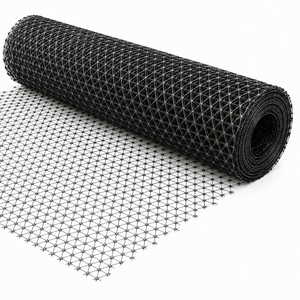
Triaxial geogrid is an integrally formed, rigid mesh structure engineered for demanding soil stabilisation and ground reinforcement applications. Manufactured from polypropylene (PP) through a process of extrusion and multi-directional stretching, it delivers exceptional tensile strength in three directions simultaneously: The machine direction (MD), transverse direction (TD), and the diagonal (45°) direction. The result is a structurally superior, mechanically interlocking grid that effectively confines and reinforces aggregate layers under load from any angle. Download the Datasheet here. Applications of Geogrid
Triaxial geogrid is suited to a wide range of civil and construction applications, including base reinforcement, subgrade reinforcement, slope reinforcement, and embankment stabilisation. It performs reliably under roads, driveways, parking lots, and retaining wall systems where multi-directional load distribution and lateral restraint are critical. How Geogrid Works
PP sheets are punched with triangular apertures and stretched under heat in multiple directions, aligning the polymer molecules to create high tensile resistance across all three axes. When aggregate is placed over the geogrid, the particles interlock within the apertures - acting like a snowshoe to distribute vertical loads over a wider footprint and prevent lateral migration of fill material in every direction. Geogrid vs Geotextile – Understanding the Difference
Geogrids and geotextiles serve distinct but complementary roles. A geotextile is a fabric-like material whose primary functions are separation (preventing base rock from sinking into soft subgrade) and filtration (allowing water to pass while retaining fine soil particles). A geogrid is a stiff, open mesh whose primary function is reinforcement and stabilisation - it locks into gravel or crushed rock to bear and distribute heavy loads across all directions of stress. How Geogrid and Geotextile Work Together
When used in combination, these two materials form a complementary dual-layer system that significantly improves the performance and longevity of civil structures:
- Preventing pumping in roadways: Over weak or muddy subgrades, the geotextile separates mud from the gravel base while the triaxial geogrid locks the gravel together in all directions - preventing rutting and bearing capacity failure under traffic.
- Reinforcing retaining walls: For walls exceeding 1-1.2 metres, geogrid layers are embedded into the backfill to anchor the wall into the earth. A geotextile placed behind the blocks filters fine soil and protects the drainage system.
- Reducing excavation costs: The combined system achieves a stronger foundation with less imported rock and reduced dig depth - a meaningful saving on larger projects. Specifications of
- Material: Polypropylene (PP)
- Structure: Integrally formed triaxial grid with triangular apertures
- Tensile strength: High in MD (longitudinal), TD (transverse), and diagonal (45°) directions
- Characteristics: Rigid and dimensionally stable
- Manufacturing process: Extrusion, punching, multi-directional stretching under heat Features & Benefits
- Triaxial tensile strength – Strength in three directions ensures consistent load distribution regardless of the angle of applied stress
- Mechanical interlock with aggregate – Triangular apertures grip gravel and crushed rock, preventing lateral movement and rutting in all directions
- Polypropylene construction – Chemically inert, UV-stabilised, and resistant to biological degradation in soil environments
- Integral grid structure – No woven joints or bonded intersections; the grid is formed as a single continuous structure for long-term reliability
- Broad application range – Suitable for roads, driveways, parking areas, slopes, embankments, and retaining wall backfill
- Reduces material and excavation costs – Enables thinner aggregate layers and shallower dig depths without compromising structural performance