
Leatherwood The Golden Ratio Cello Rosin
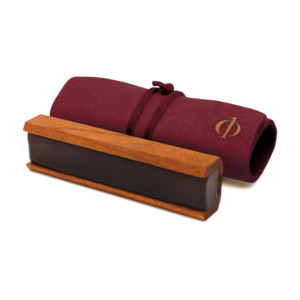
Leatherwood Bespoke Rosin is proud to celebrate a decade of craftsmanship and innovation with the launch of our 10th anniversary special edition rosin, "The Golden Ratio."
This special edition reflects our enduring commitment to harmony, precision, and artistry—qualities that the golden ratio has long symbolised in classical music and violin making. Just as master luthiers and composers have embraced this divine proportion to create masterpieces, we too have woven this mathematical elegance into our bespoke range. Our "Golden Ratio" rosin features a unique 61.8% Supple recipe, further enhanced to capture the perfect balance of grip, texture, richness, and tonal clarity. This recipe intensifies rich, deep, bold, and warm sound colours, while maintaining strong focus and soloistic qualities.
We have chosen an elegant and colourful 'Cherry' timber for the casing, with a rich burgundy Australian leather wrap, embossed in gold with the Golden Ratio symbol. These luxury materials are sourced from Australian suppliers and hand made in our workshop.
For years, we have explored the bespoke range spectrum from 100% Supple through to 100% Crisp in search of a truly balanced recipe. The Golden Ratio asks a simple question: could this be the perfect rosin? More than a formulation, it is a tribute to timeless proportion and the pursuit of musical perfection.
Why the Golden Ratio?
The Golden Ratio (1 : 1.618) is a proportion that recurs throughout nature, art, architecture, and design, long associated with a quiet sense of balance and beauty. When a whole relates to its larger part in the same way the larger part relates to the smaller, this harmonious relationship emerges—one that the human eye and ear seem to recognise instinctively. Across centuries, artists and makers have drawn upon this proportion, consciously or intuitively, to shape works that feel naturally complete and aesthetically satisfying.
In classical music, the golden ratio often reveals itself in the architecture of a composition. Climactic moments, transitions, and thematic developments frequently occur at points that closely correspond to this proportion of the work’s total duration. The result is a musical journey in which tension, movement, and release unfold with an organic inevitability, lending the listener a deep sense of coherence and emotional poise.
In violin making, this same proportion can be discerned in the instrument’s form and internal geometry. The relationships between body length, bouts, stop length, f-hole placement, and bridge position in many fine historical instruments align strikingly with these principles. Such proportions contribute not only to visual grace but also to acoustic refinement, guiding the way the instrument vibrates, resonates, and projects sound.