
Doris Lusk, 'Akaroa Harbour, Banks Peninsula' - Print - wholesale
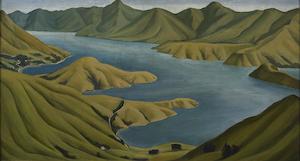
In the late 1940s Doris Lusk rented a disused farmhouse at Duvauchelle. Located at the head of Akaroa Harbour on Banks Peninsula, the house was a destination at holiday times and weekends for Lusk, her husband Dermott Holland and their young family, as well as a gathering place for artistic and literary friends. Lusk took the distinctive forms of the Banks Peninsula landscape as her subject matter in a number of works over the next few years, including this, one of her largest paintings to date.
‘What attracted me to this terrain,’ Lusk later explained, ‘was the breadth and structure of these hill forms.’ To reveal that breadth and structure, Lusk adopts a high viewpoint in Akaroa Harbour, Banks Peninsula and eliminates virtually all descriptive detail from the picture. The landscape is stripped back to bare essentials — the rhythmic, muscular forms of the hills, and the stark contrast of land, water and sky. In this, Akaroa Harbour, Banks Peninsula differs from the series of works that had immediately preceded it, in which Lusk documented the massive engineering works of the Lake Waikaremoana hydroelectric power scheme in the central North Island. There, and elsewhere in Lusk’s work, the forms of the landscape are articulated in relation to the marks of human habitation upon it. Here, it appears as if such habitation was merely a passing phase.
Like Colin McCahon’s paintings Otago Peninsula, 1949 (Museum of New Zealand Te Papa Tongarewa), and especially Takaka night and day, 1948 (Auckland Art Gallery Toi o Tāmaki), in which the landscape is similarly denuded, Akaroa Harbour, Banks Peninsula is strongly diagrammatic. McCahon had worked on Takaka night and day while staying at Lusk’s house in Christchurch the year before. The two painters would have doubtless exchanged ideas during this time, continuing an artistic dialogue begun a decade earlier in Dunedin. It was there that McCahon had first encountered Charles Cotton’s book Geomorphology of New Zealand, 1922, which became a shaping influence on his own work. It seems likely that McCahon would have shared his enthusiasm for Cotton’s ‘explicit and ordered drawing’ of the landscape with Lusk.
Te Papa Store collection of exclusive fine art prints, reproductions are drawn from the Te Papa Collections. Each print is formatted to best represent the works. Each print is sampled and colour tested alongside the original. Over the last 6 months Te Papa Photography have re-photographed works that may not have been photographed over the last 10 years to ensure Te Papa store has the latest up to date digital files for printing.
Our Premium Fine Art prints:
All giclee prints get produced on archival papers on an Epson Surecolor 64" which uses Ultrachrome K3 inks. Pigment inks that ensure the widest possible colour tonal range in digital printing.
Hahnemuhle German hing paper is 310gsm, 100% Cellulose, acid free, archival paper
Print Size: 54 x 31cm including 8mm border.
Image colours may differ on personal devices compared to the physical print due to screen variations.