
Frances Hodgkins, 'Cut melons', - Print - wholesale
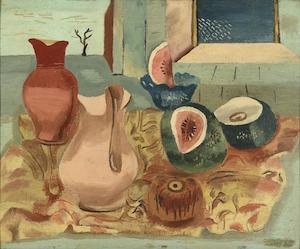
A contract with Arthur Howell’s St George’s Gallery in 1930 freed Frances Hodgkins from the burden of teaching. Like a swallow she was drawn back to the Mediterranean and the brilliant light that informed the work of so many modernist artists. In April 1931 she went to stay with Maude and George Burge in the villa they had rented in Saint-Tropez. Their villa was on the inward slope of the cliff at the far end of the town, near Paul Signac’s famous pink house with its large windows picked out in deep green tiles. Rather than the sea, it was the expansive fields, farm buildings and villages leading across the plains to the inland mountains that became the backdrop for Hodgkins’ inspiration.
In Cut melons, first exhibited in 1932, Hodgkins uses the landscape–still-life format that Howell had encouraged her to develop, but here the fruit is set against a rarely used architectural backdrop, the side walls of the building zigzagging at irregular angles into the deeper landscape. Hodgkins was a remarkable colourist, and her murky tones of aquamarine and cream are blocked and contained by a longer wall of rich red ochre that stands like a signal box near a single olive tree. Its stark branches are silhouetted against the pale sky, which is differentiated from the walls and foreground by a few wavy ‘clouds’ scratched into the paint surface with the end of her paintbrush.
This is a painter’s painting, every section drawing attention to its compositional gambit; the range of textural marks both patterns and ‘signature’. Hodgkins teases us with her brief white parallel dashes placed in the lower left of the deep-set window, suggesting ripples of light on water, subtly stretching our sense of the real. Melons, jugs and pedestal dishes — all favourite subjects — nestle in a crinkled cloth that animates the foreground. An upright slice of fruit defies gravity, lining up with the edge of the window so that the eye is drawn wittily from organic material to constructed form. Like a ‘pop-up’ picture in a book, each section is dependent on the next for its compositional and visual integrity.
Te Papa Store collection of exclusive fine art prints, reproductions are drawn from the Te Papa Collections. Each print is formatted to best represent the works. Each print is sampled and colour tested alongside the original. Over the last 6 months Te Papa Photography have re-photographed works that may not have been photographed over the last 10 years to ensure Te Papa store has the latest up to date digital files for printing.
Our Premium Fine Art prints:
All giclee prints get produced on archival papers on an Epson Surecolor 64" which uses Ultrachrome K3 inks. Pigment inks that ensure the widest possible colour tonal range in digital printing.
Hahnemuhle German hing paper is 310gsm, 100% Cellulose, acid free, archival paper
Print size: 495 x 415mm including 8mm border
Reproduction prints are as close as possible to the paper sizes available without compromising the aspect ratios of the original artworks.
Image colours may differ on personal devices compared to the physical print due to screen variations.